
What Is a Tech Pack, and Why Do You Need One for Your Clothing Brand?

Updated: 7 hours ago
You've heard the term. But what does it actually mean?

If you've spent any time researching how to start a clothing brand, you'll have come across the words "tech pack" pretty quickly. Maybe a manufacturer asked for one and you didn't know where to start, or you've just been Googling it at 11pm wondering why nobody explains it in plain English.
A tech pack, short for technical package, is the document that turns your design idea into something a factory can actually make. It's the full instruction manual for your garment, every measurement, construction detail, fabric choice, label placement, all collected into one document that a manufacturer can work from without having to guess what you mean.
A lot of fashion start-ups make the mistake of approaching a factory with a rough sketch or photograph and expect the supplier to quote a price and produce a garment from this limited information. Unfortunately, this approach is very common yet super unrealistic, and very frustrating to factories who simply don’t have the time or inclination to coach you through what is involved in product development and manufacture.
A factory needs to know exactly what your design idea entails, and the way to convey this information correctly is to prepare a tech pack for each style. Think of it like a blueprint for anything you want to manufacture. It's the difference between telling a builder "I want a house" and handing them an architect's plans. One of those conversations gets your dream house built, the other gets you a lot of questions and, probably, something you didn't want. It's exactly the same in the fashion industry.
What does a tech pack actually include?
Sometimes referred to as factory packs or style packs, a tech pack isn't just one standalone thing, it's three things combined into a single PDF for each style you're creating.
1. The colour cad
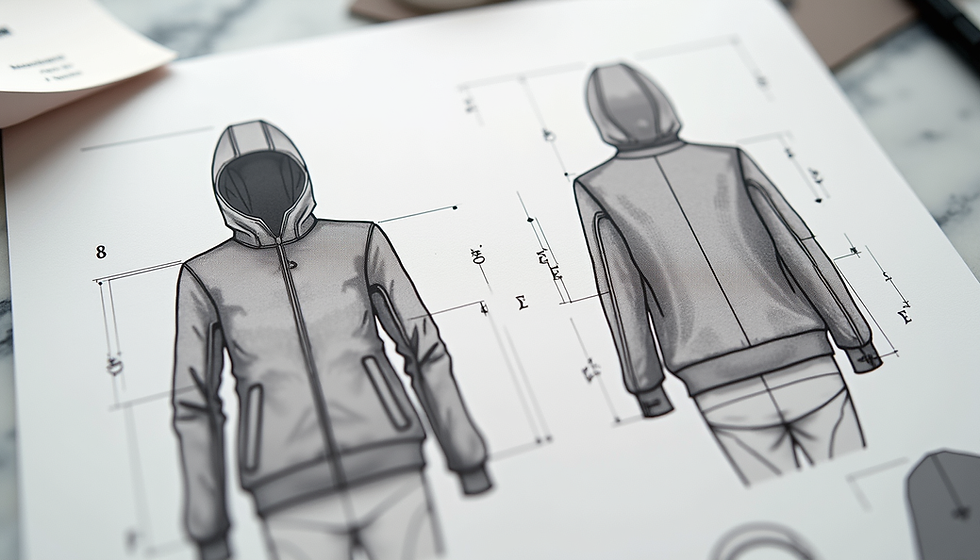
This is a digital flat drawing of your garment, in colour, showing both front and back views. It includes the Pantone codes for every colour, and details which fabrics go where. It's the visual overview, the "here's what it looks like" part of the document. Most fashion startups think this is all a tech pack is, but your manufacturer will be expecting much more than this front page.
2. The tech sheets
These are black and white drawings of the garment that drill down further into the design details, so the factory can understand how to construct the garment. The tech sheets communicate which production techniques should be used on things like prints and embellishments, and specifies information on any branded trims like zip pulls, badges and labels. Seams, stitching and buttons are referenced along with design details such as pockets, collars, cuffs, openings and fastenings. If you have an established supply chain, sometimes these fabrics and trims will be set out in a separate bill of materials (BOM). The tech sheets are where the "how to make it" lives.
3. Size specification chart
Often referred to as a “spec”, this size chart documents all the points of measure (POM) a factory will need to create a pattern, make your garment to the correct sizes, and calculate important information such as fabric consumption and an accurate price. Each point of measure is an industry-standard point on the garment such as chest, armhole, waist and length. It also covers some measurements you may not be familiar with such as front neck drop, back neck width or collar point.
A size spec is not the same as a size guide that's often displayed on retailer’s websites. These size guides are very generic guides on body sizes only, whereas a size spec shows garment sizes and is tailored to each individual style.
A size spec is usually prepared in your one desired sample size, such as medium or large for initial sampling, then graded once you are ready to go to production. The spec is what allows a factory to cut patterns correctly and grade your garment across sizes.
All 3 elements are combined into one PDF document for each style.

Why can't you just send photos or sketches to a factory?
This is one of the most common mistakes I see, and it's an expensive one. A first-time clothing brand founder pulls together their reference images from Pinterest or a rough sketch, and sends it all to a manufacturer with a message along the lines of "can you make this, and what's your price?"
A good factory can't quote from that. They don't know what fabric you want, what construction technique you're expecting, what size you're aiming for, or what the finished garment should actually feel like. So they'll either ignore you because it's unprofessional, come back with a long list of questions you'll struggle to answer, or they'll fill in the blanks themselves and produce something that looks nothing like what you had in mind. Either way, you're starting from scratch on your sampling process, and that costs time and money.
Factories work with tech packs because it's the only way to get a reliable quote and a reliable sample. It's not gatekeeping, it's just how the manufacturing process works. The more clearly you can communicate what you want, the better the outcome, the fewer rounds of samples you'll need and the cheaper it will be in the long-run.
What can go wrong without a tech pack?
A lot of founders skip tech packs early on because they either don't know they need one, or they're trying to save money. It's understandable when you don't know any better, but it tends to create exactly the problems you were hoping to avoid.
Without a tech pack, you're handing creative control to a factory that doesn't fully know your brand, your vision, or your customer. If something goes wrong with a sample, and something almost always does, you don't have a reference document to point to, or prove what was agreed. In addition, you can't get an accurate comparison quote from another supplier, or pass your design to a different factory if the relationship breaks down.
A tech pack is also what shows a manufacturer you're serious. Factories receive a lot of enquiries from clothing brand startups, who have all the red flags of needing their hand held throughout the whole process - in short, not the most desirable of clients. Arriving with professional tech packs tells them you're not one of those enquiries, and that matters when it comes to negotiating MOQs, timelines, and their willingness to work with a smaller startup fashion brand.
Trying to create a garment without a tech pack leads to so many problems and can waste a lot of time and money for both the factory and the start-up brand. The money you invest in professional tech packs in the beginning, will save you a lot of time and money in the long term. It will also show prospective suppliers that you are serious and committed to your brand, and increase your chances of forging good relationships with them from the beginning.
Need a production-ready tech pack for your clothing brand?
I create detailed, manufacturer-ready tech packs for first-time founders across womenswear, menswear, childrenswear and sportswear. You bring the ideas, I handle the technical side.
Do you need to create a tech pack yourself?
No, and for most founders, being brutally honest, you shouldn't try. I say that because creating a professional tech pack requires knowledge of technical garment construction, how factories work, how to write spec sheets, and how to produce accurate CAD drawings. It's a specialist skill that combines design competency with years of knowledge, and it's what a professional fashion designer is for.
What you do need is a clear idea of what you want to create, an understanding of the key features of your garment, and a designer you can communicate that vision to. From there, it's the designer's job to translate your idea into the kind of documentation a factory can work from.
That's exactly what I do with my clients on the daily - you bring me the concept, and I'll turn it into a complete, professional tech pack that any manufacturer can work with.
If you're wondering where a sketch fits into all of this, this post explains the difference between a sketch and a tech pack
When do you need a tech pack?
My answer is always before you approach a manufacturer.
If you're at the ideas stage, still figuring out what you want to create, it's OK to play about with rough sketches, make Pinterest boards or gather inspiration together like photos. But the moment you're ready to get a sample made, get a costing, or have a serious conversation with a factory, then you 100% need one. It's the thing that makes all of those conversations productive rather than frustrating.
The founders who skip this step tend to find out why it matters the hard way, through poor samples, wasted sampling costs, or a factory that quoted blind and delivered something completely different. Getting a tech pack done properly at the start of your design and product development is almost always cheaper than fixing what happens when you don't.
Get ahead of the competition by adopting the approach fashion professionals follow for manufacturing their products, and make sure you prepare detailed tech packs for your fashion brand.
If you have any questions, comments or feel you need help with tech packs for your collection or any aspect of launching your fashion brand then get in touch.
Want your designs turned into professional, factory-ready tech packs?
I work with clothing brand founders at every stage, from rough idea to complete tech pack. Book a free 20-minute call and we'll talk through what you need.

About Michelle Ramsay – The Fashion Expert®
Michelle Ramsay is a fashion designer, startup mentor and fashion brand consultant with over 20 years of industry experience helping clothing brand founders bring their fashion brand ideas to life. She's worked on brands such as ASOS, Gymshark, French Connection, M&S and Topshop.
Through The Fashion Expert®, she works with founders on everything from design development and tech packs to manufacturing guidance, launch planning and one-to-one mentoring, helping turn messy ideas and Pinterest boards into real collections ready for production.
After working with more than 400 fashion founders, Michelle has become known for helping people without fashion industry backgrounds navigate the process with clarity, confidence and expert support.
See you in the front row,
Michelle Ramsay - The Fashion Expert®
Comments