
What’s The Difference Between A Sketch & A Tech Pack?

Updated: Sep 21
If you're confused about this, you're not alone
You've got a Pinterest board full of ideas, you know the vibe of your brand, you can picture the garments, you know who they're for. But somewhere between "I have this idea" and "I have a clothing brand," there's a gap around the design part you can't quite work out.
And then someone mentions CADs and tech packs, and suddenly you're wondering whether you need to learn how to sketch professionally, buy Adobe Illustrator, whether you should be sending your inspiration photos straight to a manufacturer to see what they can do with them, and is there any real difference between a sketch and a tech pack.
Let's stop right there and clear this up, because this is where so many fashion startups go wrong - these are two very different things, and understanding the difference will save you a lot of time, money, and frustration.
What Is a Sketch?
A sketch is your design in visual form. It shows the style, the overall silhouette, the key features, the general feel of the garment. It's the starting point for any design idea, and it can take lots of different forms.
Sketches can be hand-drawn, digitally created in apps like Procreate or Illustrator, rough outlines, or beautifully rendered illustrations, others scribble something on a notepad that only they can interpret. Both are valid starting points.
But the thing that catches a lot of founders out is a sketch, even a really good one, is not enough to get something manufactured properly. It shows what something looks like, but it doesn't tell a factory how to make it.
And if the idea of sketching at all makes you nervous, I'd encourage you to set that worry aside right now, because most of the founders I work with can't draw.
What Is a Fashion Flat or CAD?
A fashion flat, sometimes called a technical drawing or a CAD, sits somewhere between a sketch and a full tech pack. It's a step up from a rough sketch, but it's not the complete picture on its own either.
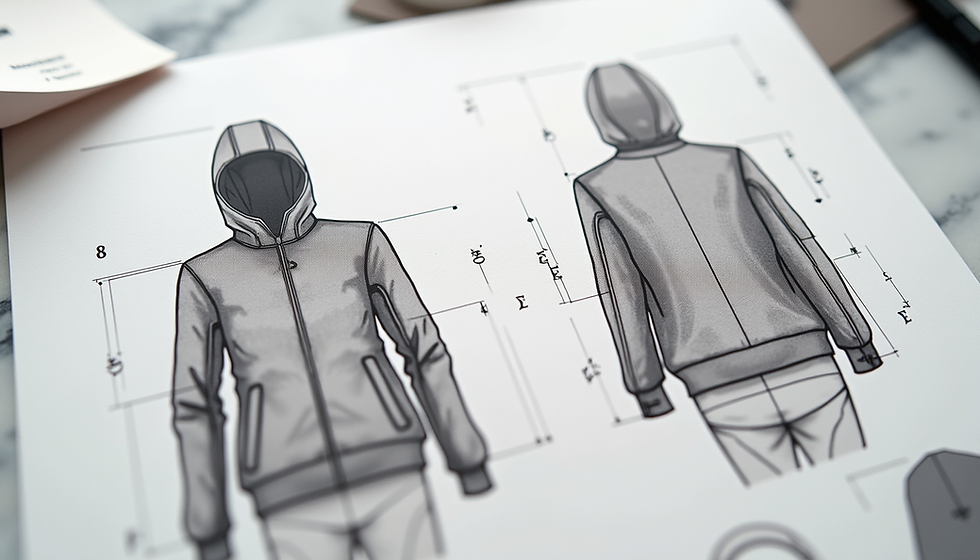
A fashion flat is a drawing of the garment laid flat, not on a body, not stylised, not posed. It's drawn to proportion, and includes a lot more detail than a sketch, things like stitching lines, seam placement, pocket positions, zip and button placement, logo or badge positioning, and any other design details that need to be visible and accurate. You'll usually see a fashion flat in colour, showing the Pantone references and colourways, and then again in black and white, which is where the construction detail becomes clearer.
Because it's not on a body and it's not stylised, there's much less left to interpretation than there is with a sketch. A factory looking at a fashion flat can see a lot more of what you're trying to create than they could from a hand-drawn sketch or a reference photo.
But here's what's important to understand: a fashion flat on its own still isn't enough to manufacture from. It shows how the garment looks, but it doesn't tell a factory how to construct it, what fabric to use, what the measurements are, how to grade the sizes, or where the labels go. A fashion flat is actually one element within a tech pack, not a replacement for one.
So if someone has told you that you need a CAD or a technical drawing, what they really mean is that you need the fashion flat component of a full tech pack, and a full tech pack is what actually gets your garment made properly.
What Is a Tech Pack?
A tech pack, short for technical package, is the instruction manual or blueprint for your design. It's what your manufacturer needs to understand exactly how to make your garment, down to the last detail, without having to guess, interpret, or fill in the blanks themselves.
Where a sketch shows the idea, a tech pack shows the how.
A complete tech pack includes:
Front and back technical drawings, called fashion flats, created digitally to industry standard
Construction notes telling the factory how to manufacture the item, the specific techniques, the finishes, the stitching
Measurements and a size chart with every point of measure a factory needs to cut a pattern and grade your sizes
Pantone references, colourways and any variations across the range
Branding and labelling placement, so the factory knows exactly where labels, tags, badges and any woven or printed elements go
Technical information on prints, embroideries or embellishments, including placement, sizing and production techniques
Any other technical notes specific to the garment, like the type of machinery needed or a particular finish
That's a lot of information, and it all needs to be accurate, industry-standard, and in a format that any factory, anywhere in the world, can pick up and work from.

Need a production-ready tech pack for your clothing brand?
I create detailed, manufacturer-ready tech packs for first-time founders across womenswear, menswear, childrenswear and sportswear. You bring the ideas, I handle the technical side.
Why You Can’t Just Send Photos to a Factory
This is one of the most common mistakes I see, and it's an expensive one to fix. Founders will often pull together their reference images, a few screenshots, maybe a sketch, and email them to a manufacturer asking for a quote and a sample.
The problem with this is a manufacturer doesn't know what fabric you want, what size you're aiming for, how the seams should be finished, where the label goes, whether that stripe is engineered or repeated, what the zip pull looks like, or what the inside of the collar should feel like. So they'll either come back with a list of questions that takes weeks to work through, and you probably won't fully know the answer to, or they'll make decisions for you and produce something that looks nothing like what you had in your head.
I've had founders come to me after exactly this situation, sometimes months into a sampling process, sometimes hundreds of pounds down, sometimes with a factory relationship that's broken down completely because nobody could agree on what was originally asked for. Starting again from scratch, with proper documentation, is always more expensive than doing it right the first time.
So do you need to learn design skills to start a clothing brand?
Not at all. You do not need to learn how to create technical designs yourself, master Adobe Illustrator or take a fashion design degree.
What you need is a clear idea of what you want to create, and a professional designer who can translate that into the documentation a factory needs.
That's exactly where I come in - you can bring me the very raw concept, whether that's a rough sketch, a Pinterest board, a reference image, or just a clear description of what you're trying to create, and I'll turn it into a complete, factory-ready tech pack that any manufacturer can work from. I'll chat through everything with you to make sure we are on the same page with the design handwriting and ideas, then transform this into professional designs for you.
How sketches and tech packs actually work together
Here's how the process typically looks in practice. You start with your idea, in whatever form it currently takes. That might be a hand-drawn sketch, a saved photo, a reference garment you own, or even just a very clear description. The sketch, or the idea behind it, gives us the starting point: the silhouette, the key features, the feel you're going for or the problem you're trying to solve.
From there, a professional designer like myself uses that starting point to create the technical documents a factory needs, starting with the colour CAD, the tech sheets with all the construction details, and then the size specification chart. The inspiration photos or the rough sketch informs the designer and acts as that starting point, but the finished tech pack is what gets sent to the factory.
They're not interchangeable, and trying to skip from inspiration straight to manufacturing, without the step in the middle, is where most founders waste their time and their sampling budget.
What If I’m Still in the Pinterest Phase?
That's fine - everyone starts there, and it's not a problem that needs fixing.
What matters is understanding that there will come a point, when you're ready to get samples made or approach a manufacturer, where you'll need proper technical documentation. The earlier you understand what that means, the better prepared you'll be when that point arrives.
If you're currently at the ideas stage and want to get a sense of what the process looks like from idea to tech pack, you can book a complimentary call and I'll walk you through the whole process of transforming your ideas into professional designs. We can talk through what you're creating, what stage you're at, and what you'd need to move forward properly.
You can also read more about my tech pack service here.
About Michelle Ramsay
Michelle Ramsay is the founder of The Fashion Expert® — a freelance fashion designer, startup mentor and consultant with over 20 years of industry experience. She has worked with brands including Gymshark, Tailored Athlete, ASOS, Topshop and M&S, and has helped hundreds of first-time founders design, manufacture and launch their clothing brands. If you're ready to take the next step, book a free discovery call.
See you in the front row,
Michelle.


Comments